We live in an age where everyone is expected to “pick up skills” like they’re packet nasi goreng from a warung. Quick, cheap, instantly satisfying. Bosses want you to “adapt quickly”, friends are “learning Web3 on the side”, and TikTok makes it look like you can become a violinist in a month if you just believe in yourself. Meanwhile, you’re Googling “what is Docker” for the fifteenth time.
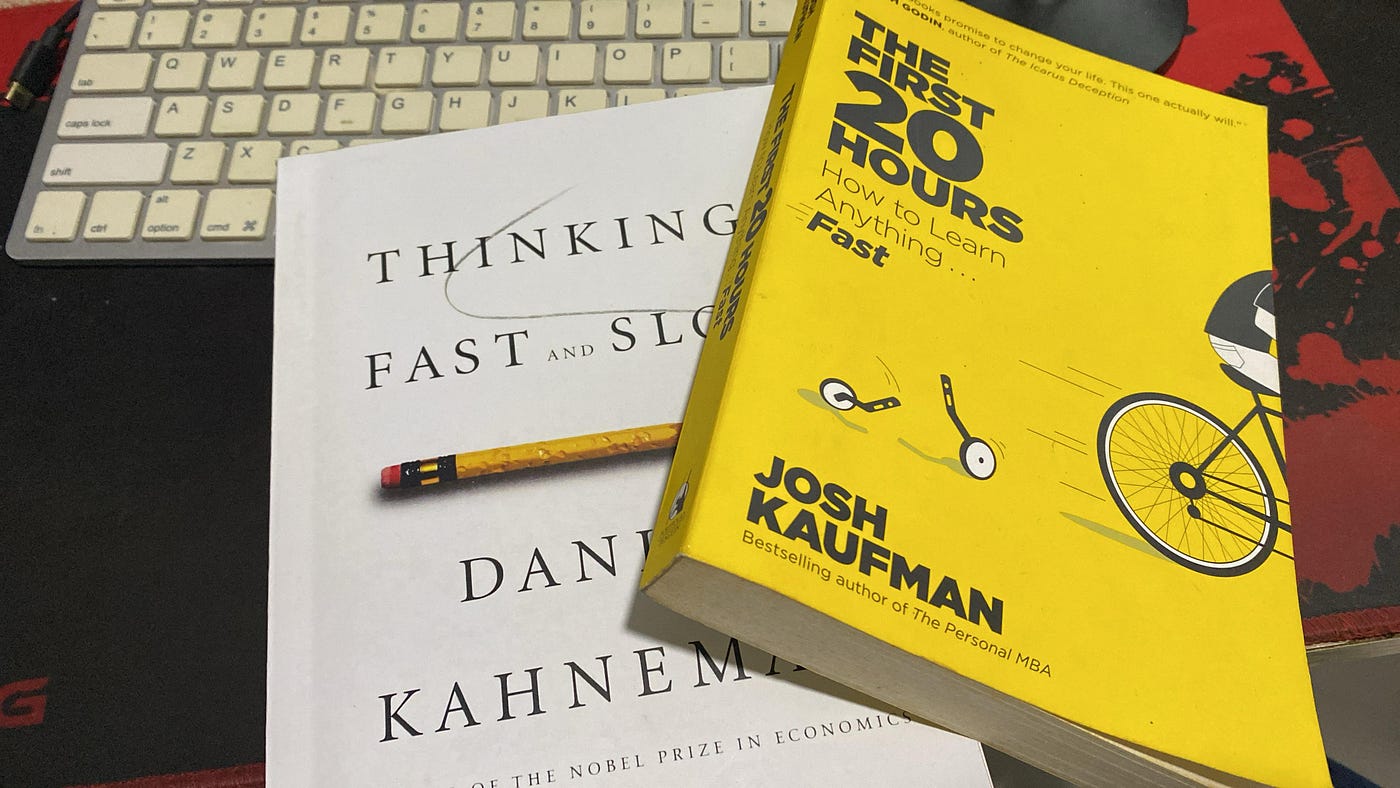
Here’s the truth. Learning new things is not magic. It’s science, psychology, and sweat. If you understand how your brain actually learns, you can stop fighting it. Two books give us the cheat codes: The First 20 Hours by Josh Kaufman and Thinking, Fast and Slow by Daniel Kahneman.
One teaches you how to break learning into manageable chunks. The other explains how your brain makes decisions. Combine them and learning becomes a system instead of a headache.
Let’s break it down.
The Myth of Mastery vs the Reality of 20 Hours
Most people never start because they think they need 10,000 hours. That number comes from Malcolm Gladwell’s oversimplified take on Anders Ericsson’s research. Kaufman cuts through the noise.
You don’t need mastery. You need about 20 hours of focused, deliberate practice to go from clueless newbie to functional amateur.
Twenty hours. Less than one season of your favourite K-drama. Spread it out. Forty minutes a day for a month. Enough to actually use the skill.
This reframing removes the biggest blocker. Intimidation. You are not signing up for a life sentence. Just a month of showing up.
System 1 and System 2: The Brain’s Double Act
Kahneman explains that your brain runs on two modes.
- System 1: fast, intuitive, automatic. Gut reactions.
- System 2: slow, deliberate, logical. Actual thinking.
When learning something new, you start in System 2. Step by step, conscious effort. With practice, parts migrate to System 1.
That’s why driving feels impossible at first, then suddenly you arrive home with no memory of the journey.
Too much System 1 and you fake confidence. Too much System 2 and you burn out. The goal is a smooth handover.
- Chunk practice into micro-drills. Small snippets, not full projects.
- Slow down for hard parts. Let System 2 do its job.
- Automate with repetition. That’s System 1 taking over.
- Add real-world context. Messy practice forces integration.
- Schedule reviews. Prevent bad habits from fossilising.
Think of learning as a relay race. System 2 starts. System 1 finishes.
Define What “Good Enough” Means
Do you want to “learn guitar” or play three songs at a jam session? Do you want to “learn data science” or build a sales prediction model?
Vague goals overload your brain. Clear targets focus it.
Once “good enough” is defined, you stop drowning in infinite options.
Deconstruct the Skill
Every skill is a bundle of sub-skills. Coding is syntax, debugging, logic, reading docs. Break it down.
The 80/20 rule applies. Focus on the parts that actually matter.
If you’re learning Spanish for travel, skip grammar theory. Learn greetings, directions, numbers, food. Grammar can wait.
Remove Barriers to Practice
You do not need motivation. You need fewer obstacles.
Make practice stupidly easy. Guitar on a stand. Coding environment always ready. Let laziness work for you.
Commit to 20 Hours
Twenty hours is long enough to get past despair, short enough to feel doable. Commit first. Judge later.
- Focused practice
- Pushing through frustration
- Paying attention to feedback
You are rewiring your brain during these hours.
Embrace the Ugly Stage
Everyone is bad at the start. Missed chords. Broken code. Wrong words.
That’s not failure. That’s the entry fee.
Learning is a Process, Not a Miracle
No shortcuts. No hacks. Just understanding how your brain works and setting it up to win.

Comments
Post a Comment