The Introverted Broke Man
The Myers-Briggs Type Indicator (MBTI) has gained a curious kind of cultural immortality in the corporate world. Much like fans of Hogwarts boast about their house allegiance, professionals increasingly flaunt their MBTI personality types as badges of identity, sometimes even over and above their actual job titles.
But while the MBTI might feel like a fun shortcut to understanding people, its widespread use as a serious hiring or promotion tool is deeply problematic. It’s time to look honestly at why MBTI shouldn’t guide workplace decisions and what to do instead.
The Allure and the Limitations of the MBTI
MBTI was inspired by Carl Jung’s psychological theories on personality archetypes but was formalized by Isabel Briggs Myers and her mother Katharine Cook Briggs, neither of whom had formal credentials in psychology.
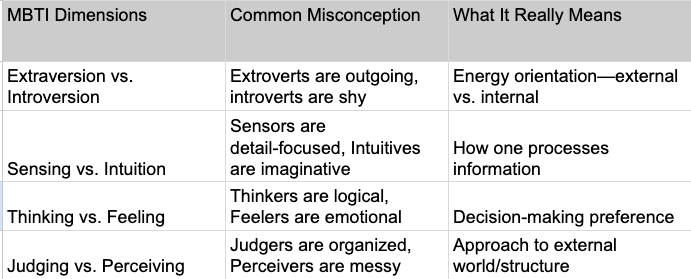
The MBTI sorts individuals into 16 personality types based on four dichotomies: Extraversion vs Introversion, Sensing vs Intuition, Thinking vs Feeling, and Judging vs Perceiving. This framework offers straightforward labels like “INTJ” or “ESFP” that feel more relatable than clinical jargon.
Because of its simplicity and appeal, MBTI is excellent for:
- Encouraging self-reflection by prompting people to consider their preferences
- Sparking conversation as an easy social or workplace icebreaker
- Providing a sense of identity that feels accessible and human
Yet these strengths also reveal its limitations. MBTI is a preference indicator, not a personality test in the empirical sense.
This matters because psychometric tools used in hiring or leadership decisions must be both valid and reliable. Multiple studies show MBTI scores can change dramatically on retesting, with up to half of participants receiving a different type after only a few weeks.
The Danger of Oversimplified Labels
In the workplace, MBTI does harm when treated as a rigid blueprint for behaviour. People are not four-letter codes. They are dynamic and context-dependent.
For example, being labelled an Introvert often leads to assumptions about shyness or social avoidance. In reality, introversion simply reflects how someone recharges energy. Many introverts thrive in leadership roles or public-facing situations.
Similarly, Judging types may prefer structure, but that does not mean they cannot adapt or act spontaneously.
Reducing people to types encourages stereotyping rather than understanding. It replaces curiosity with intellectual shortcuts.
Why Using MBTI for Hiring is a Risk
When MBTI enters hiring, team-building, or promotion decisions, it introduces serious risks:
- Lack of scientific support for predicting job performance
- Poor reliability due to unstable results over time
- Self-fulfilling prophecies that limit employee growth
- Distraction from observable skills and behaviours
At that point, it becomes astrology wearing a business suit.
What Should Organisations Do Instead?
Leaders need insights grounded in observation and evidence, not personality branding.
What actually matters:
- How people behave under pressure
- How reliably they manage time and commitments
- How they respond to failure and feedback
- How they collaborate with others
These indicators provide far richer insight into performance and potential than MBTI ever could.
Final Thoughts
MBTI is fun. It can spark reflection and conversation. But it is not a hiring oracle or leadership crystal ball.
Using it as one introduces bias, reinforces stereotypes, and weakens organisational decision-making. Stop treating colleagues like corporate Pokémon and start evaluating them as complex, evolving human beings.
Sources and Further Reading
- Pittenger, D. J. (2005). Cautionary Comments Regarding the Myers-Briggs Type Indicator. Consulting Psychology Journal: Practice and Research, 57(3), 210–221.
- Boyle, G. J. (1995). Myers-Briggs Type Indicator (MBTI): Some Psychometric Limitations. Australian Psychologist, 30(1), 71–74.
- Grant, A. M. (2013). Rethinking how personality relates to job performance. Harvard Business Review.
- Hogan, R., & Kaiser, R. B. (2005). What we know about leadership. Review of General Psychology, 9(2), 169–180.

Comments
Post a Comment